
White County Arrest to Court Record
White County post-arrest records split into two tracks. The arrest and intake track starts at the White County Detention Center, where booking data, roster charges, bond entries, holds, and custody status may appear. The court track starts when the case moves to a filing source: Search ARCourts, the White County Circuit Clerk, a district court division, or the 17th Judicial District Prosecuting Attorney. Those sources show what was filed in court, not just what was first entered at the jail.
The practical sequence is arrest, transport to the jail, booking, a first appearance without unnecessary delay, prosecutor review, and then a court case if formal charges are filed. The White County Circuit Clerk maintains criminal case files, proceedings, dockets, dispositions, and court-authorized warrants, writs, and summons. The prosecutor may file, amend, reduce, decline, or later dismiss charges. That is why a booking charge on the roster can differ from a charge listed in a White County court record.
For the jail side of the same event, use White County jail inmate records to check current custody, booking data, and bond status. For booking photos, use White County jail roster mugshots instead of expecting the court case file to act as a photo database.
White County Court Records Search
Search ARCourts is the Arkansas Judiciary public case-search portal for courts that use the Contexte Case Management System. The Judiciary says the portal can be searched by party name or case number and may show parties, judge, filings, charges, dispositions, future events, judgments, and document links for some public court records. Internet access is limited by Arkansas Supreme Court Administrative Order 19, so a missing online result does not always mean no court record exists.
The Search ARCourts portal is the best first online step for White County court records after an arrest. Start with the person's name, then narrow by county, court name, case number, citation number, or date fields if the first search is too broad. If the arrest was recent, the jail roster may appear before the court case. If the case is older, sealed, juvenile, or restricted, the clerk may be the better source than the public portal.
The Search ARCourts public case-search screen is the source for the portal view shown here.
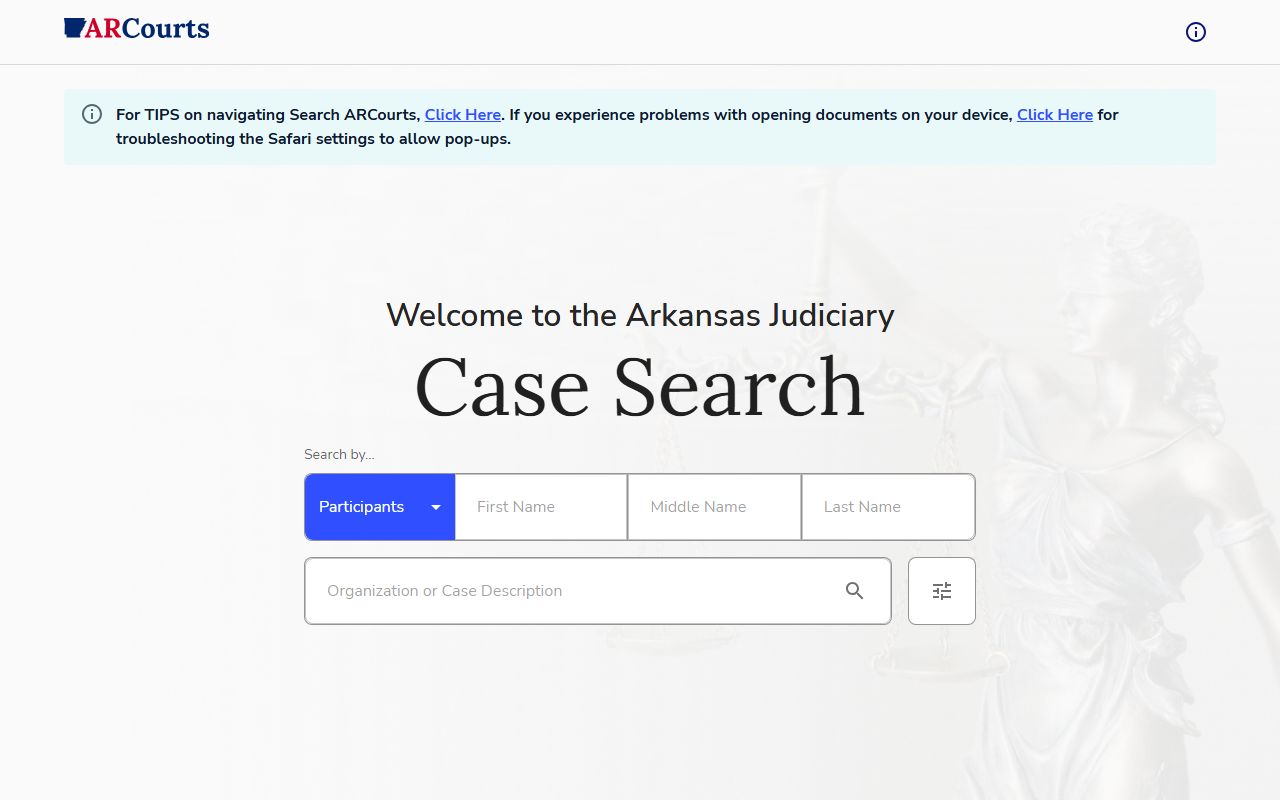
Use the portal for formal case information, then compare any court charges against the jail roster if custody status still matters.
| Field Label | Type | Required | Options / Format Notes |
|---|---|---|---|
| Search by | Dropdown | Unspecified | Visible options include Participants and Cases. |
| First Name | Text | No | Maximum length observed as 200 characters. |
| Middle Name | Text | No | Maximum length observed as 200 characters. |
| Last Name | Text | No | Exact match for fewer than three characters; starts-with behavior for three or more characters was observed in code. |
| Case Number or Citation Number | Text | No | Searches case ID and citation number. |
| Organization or Case Description | Text | No | Broader search context; maximum length observed as 200 characters. |
| Advanced filters | Icon button | No | Opens specific search options. |
| Case Type | Autocomplete / dropdown | No | Includes criminal and noncriminal types, with observed references such as ARREST WARRANT and APPELLATE FELONY. |
| County / County Name | Autocomplete / dropdown | No | Use White County to narrow local results. |
| Court Name | Autocomplete / dropdown | No | Narrows by court location. |
| Date of Birth | Date / text | No | Found in participant advanced code as BirthDate. |
| Driver License Number | Text | No | Found in participant advanced code as DlNumber. |
| Start Date / End Date | Date | No | Advanced filters normalize start and end times. |
| Docket Code / Docket Description | Autocomplete / dropdown | No | Advanced case filter. |
White County Arrest Charging Records
After booking, the charge record becomes more formal when a charging document is filed. Arkansas cases may involve a complaint, an information, or an indictment, depending on the court level and case path. The research for White County confirms that the Prosecuting Attorney is the charging authority after arrest. The prosecutor's office decides what charge to file, whether to amend or reduce it, whether to decline prosecution, and how to move through plea, trial, dismissal, or another outcome.
The White County Prosecuting Attorney page identifies the local prosecuting office for the 17th Judicial District.
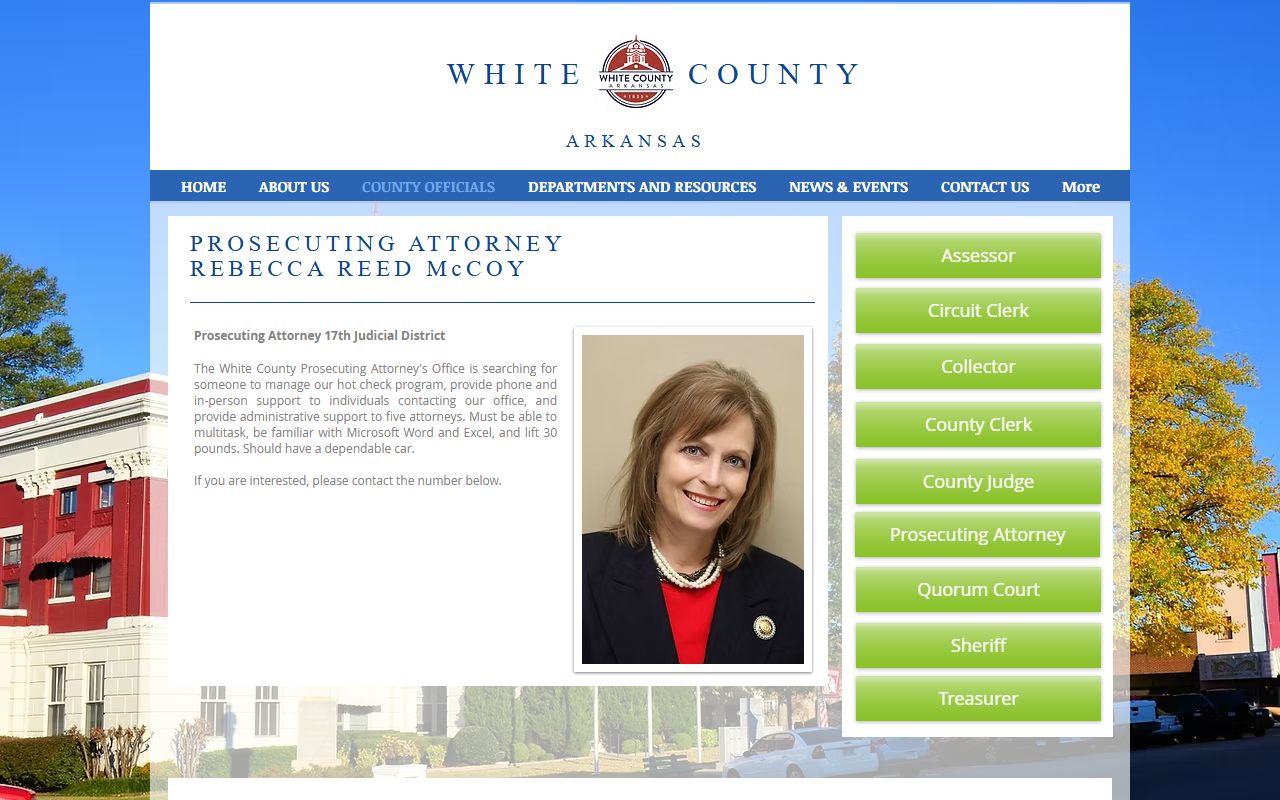
That office is the local charging source to distinguish from the jail's booking entry and from later court dispositions.
| Document | Who Usually Files or Authorizes It | What It Does | Why It Matters After Arrest |
|---|---|---|---|
| Complaint | Officer or prosecutor, depending on case type | States the alleged offense and starts or supports a criminal case. | May be the first court record tied to a jail booking. |
| Information | Prosecutor | Sets out formal charges selected by the prosecuting attorney. | Often shows how the prosecutor framed the case after review. |
| Indictment | Grand jury | Accuses a person of an offense through grand-jury action. | Less routine than other filings, but still a formal charging record. |
Note: The booking charge is a jail record; the complaint, information, or indictment is a court record.
White County Charge Status
A White County court record after arrest is not frozen on the day of booking. Charges can be added, amended, reduced, dismissed, or resolved by plea, verdict, acquittal, or another court action. Search ARCourts and the Circuit Clerk are the main sources for docket events and case-file status. The jail roster can help show custody and bond, but it should not be treated as the final charge history.
| Status | Plain Meaning | What to Check |
|---|---|---|
| Pending | The charge is open and has not reached a final disposition. | Look for future court events, bond terms, and docket entries. |
| Amended | The formal charge changed after filing. | Compare the current charge to the first filed charge and booking entry. |
| Reduced | The case moved to a lesser charge or lower level. | Check the latest docket text and disposition field. |
| Dismissed | The court case or charge was ended without a conviction on that count. | Confirm whether all counts were dismissed or only one charge. |
| Nolle prosequi | The prosecutor chose not to proceed on the charge. | Read the docket and any order, because related charges may remain. |
| Guilty plea or conviction | The case reached a finding or plea that supports judgment. | Check sentence, fines, probation, jail credit, and appeal events. |
| Acquittal | The person was found not guilty on that charge. | Confirm whether other counts in the same case had a different result. |
White County Bond and Holds
Bond information often starts on the jail side but can be tied to the court case. White County research found roster bond fields such as bond amount, bond type, bond status, deposit amount, total bond amount, total due, and bond fees. Observed bond terms included Paper Bond, Cash Bond, Included, Not Bondable, and Available to Post. Arkansas Rule of Criminal Procedure 8.1 requires an arrested person who is not released by citation or other lawful means to be taken before a judicial officer without unnecessary delay.
Rule 9.2 materials describe money bail as a court decision made after the judicial officer considers whether other conditions will reasonably ensure appearance. A cash bond is paid according to jail or court instructions. A surety bond involves a licensed bail agent. A PR or own-recognizance release allows release based on a promise and conditions. A no-bond or not-bondable entry means money alone may not release the person.
Bond-related holds can come from pending warrants, failure-to-appear cases, probation or parole holds, ADC commitment, other counties, federal custody, or immigration detainers. White County materials did not publish a standalone bond-posting fee schedule or counter-hours page, so the practical route is to call the White County Detention Center and the relevant clerk before paying any person or company. Use official numbers and licensed Arkansas bail-bond resources.
White County Warrants and FTA
No official searchable White County active-warrant portal was located in the research. The WCSO Most Wanted page exists, but it had no listed wanted entries and no search form at inspection. For court records after an arrest, the White County Circuit Clerk is the key official warrant source for circuit-court records because the clerk issues summons, warrants, and writs authorized by the circuit court for delivery by the sheriff.
Failure to appear, often shortened to FTA, can create a bench warrant or court hold. A bench warrant is usually issued by a judge when a person misses court or fails to comply with a court order. An arrest warrant authorizes arrest. A search warrant authorizes a search or seizure and is not the same thing. A fugitive or outside-agency hold means another jurisdiction wants custody or notice before release.
- Where to Check
- Search ARCourts for filed cases, FTA events, warrant case types, and case or citation numbers.
- Who to Call
- Call the Circuit Clerk for circuit-court case-file questions, or the appropriate district court division for lower-court traffic and misdemeanor matters.
- Custody Follow-Up
- If a warrant arrest has already happened, search the White County jail roster for current custody, bond, and hold status.
- Law-Enforcement Routing
- Use the sheriff's official main office number for law-enforcement confirmation and routing when a warrant source is unclear.
White County Charges vs Convictions
A charge is an accusation. A conviction is a court result. That difference matters in White County court records after an arrest because the roster may list one or more alleged offenses before the prosecutor files or changes formal charges. A court charge still is not a conviction until there is a guilty plea, a finding, or a judgment. Pending, dismissed, nolle prosequi, amended, reduced, acquitted, and convicted are different legal outcomes.
| Point of Comparison | Charge | Conviction |
|---|---|---|
| Stage | Accusation after arrest, warrant, or prosecutor filing. | Final or formal result after plea, finding, or judgment. |
| Where It Appears | Roster entries, charging documents, and court dockets. | Disposition, judgment, sentence, probation, or related docket entry. |
| Can It Change? | Yes. It may be amended, reduced, added, or dismissed. | It can be appealed or later affected by sealing, but it is no longer just an allegation. |
| Reader Risk | Calling a charge a conviction overstates the record. | Ignoring the final disposition can understate the record. |
White County Sealed Court Records
Public access to White County court records after arrest is broad but not unlimited. Arkansas FOIA opens public records to inspection and copying by Arkansas citizens unless an exemption applies. Court records also follow Administrative Order 19, which is one reason some case information may not appear online. Juvenile matters, sealed records, medical or privacy data, security-sensitive jail records, and active-investigation material may be withheld or limited.
Arkansas DPS and ACIC materials identify sealing forms for qualifying criminal-history matters. The research notes Ark. Code section 16-90-1405 and Act 1460 sealing forms for misdemeanor and violation sealing. A filed, judge-approved order must be forwarded, and ACIC says it has 30 days from receipt to complete its processing. The term expunged is often used in casual speech, but Arkansas materials commonly frame this process as sealing.
| Point of Comparison | Sealed | Expunged |
|---|---|---|
| Practical meaning | Public access is restricted after a court order. | Often used to mean cleared from public view, but local forms should be checked for the precise Arkansas process. |
| How it starts | Petition and order process through the proper court when eligible. | Do not assume destruction of all records without a specific court order or statute. |
| Public portal effect | The public case result may be limited or no longer visible online. | Online visibility depends on the actual order and how the record custodian processes it. |
| Best source | White County Circuit Clerk, district court, and Arkansas DPS or ACIC forms. | The originating court and state criminal-history process. |
White County Court Contacts
When Search ARCourts does not answer the question, route the inquiry to the office that owns the record. The Circuit Clerk is the circuit-court record source for criminal case files, proceedings, dockets, dispositions, and court-issued warrants. The prosecutor is the charging authority after arrest. The jail is the custody and bond-status source, not the final court-record custodian.
The White County Circuit Clerk page is the source for the court-record duties and contact details shown below.
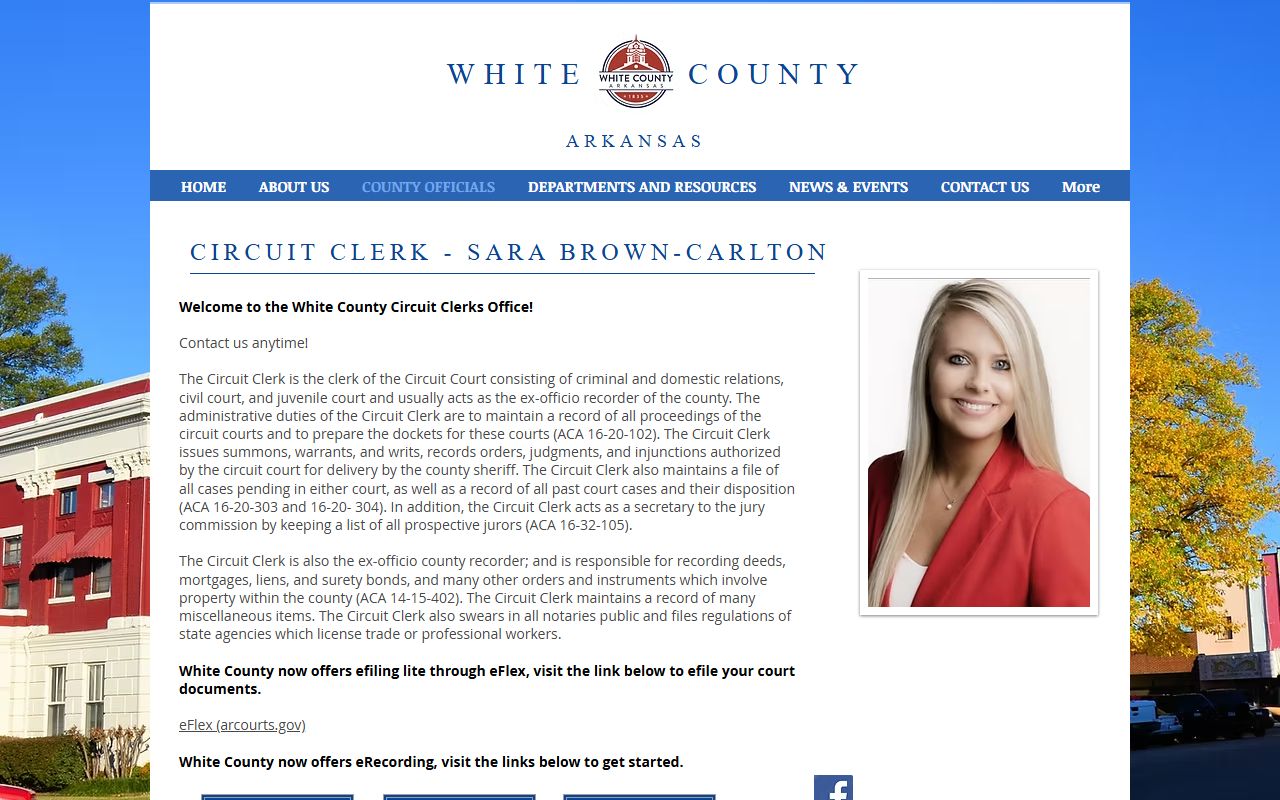
Use the clerk for case-file and disposition questions after checking the public search portal.
White County Circuit Clerk
Sara Brown-Carlton
White County Courthouse
300 North Spruce
Searcy, AR 72143
501-279-6203
501-279-6223
Email: sara.carlton@whitecircuitclerk.com
Hours: Monday-Friday, 8:00 a.m.-4:30 p.m.
17th Judicial District Prosecuting Attorney
Rebecca Reed McCoy
2407 Taylor Rd.
Searcy, AR 72143
501-279-6236
Fax: 501-279-2072
Hours: Monday-Friday, 8:00 a.m.-4:30 p.m.
White County Detention Center
1600 E Booth Suite 100
Searcy, AR 72143
501-278-8050
Use for current custody, jail bond entries, booking status, and holds.
White County Record Limits
White County court records after arrest can help explain what happened in a criminal case, but they are not a substitute for a lawful background-check process. Arkansas VINE may provide custody and court-event notifications from county jails, Arkansas DOC, probation, parole, post-release supervision, and court information from prosecuting attorney offices. Sentenced state-prison custody should be checked through the Arkansas Department of Corrections locator, while federal sentenced prisoners use the BOP locator.
A casual court lookup can miss restricted cases, sealed records, recent filings not yet indexed, and agency holds that are not court dispositions. For employment, housing, credit, insurance, licensing, or other regulated screening, use a compliant screening process instead of a public web search. Always verify a court outcome with the clerk or the originating court before relying on it.
Important: This private resource is not a consumer reporting agency and cannot be used for FCRA-covered screening decisions.